ព្រះពុទ្ធសាសនាបានក្លាយជាគ្រឹះយ៉ាងមាំសំរាប់កម្ពុជា។ គេហទំព័រនេះនឹងចែកចាយពត៌មានទាក់ទងនឹងព្រះតេជគុណព្រះ គ្រូលួន សាវ៉ាតដែលកិច្ចការនិងសកម្មភាពរបស់ព្រះអង្គទាក់ទងនឹងការលើកស្ទួយសុខមាលភាព និងយុត្តិធម៌សង្គម ដោយក្រុមអ្នកស្រឡាញ់ព្រះពុទ្ធសាសនាខ្មែរ។ Buddhism has been the main foundation of Cambodia. This blog will attribute to Preah Krou Venerable Luon Sovath whose works and activities are engaging and promoting social wellness and justice by the group of Khmer Buddhist devotees.
"I accept to die with my saffron robe, I will not allow the authority to arrest and disrobed me as I have done nothing wrong in the Buddhist Vinaya. By this order, I cannot travel or escape to stay in any temple in the country, I must stay in this temple and accept to die in this place as a monkhood".
Listen the report by RFA today (audio embedded here),
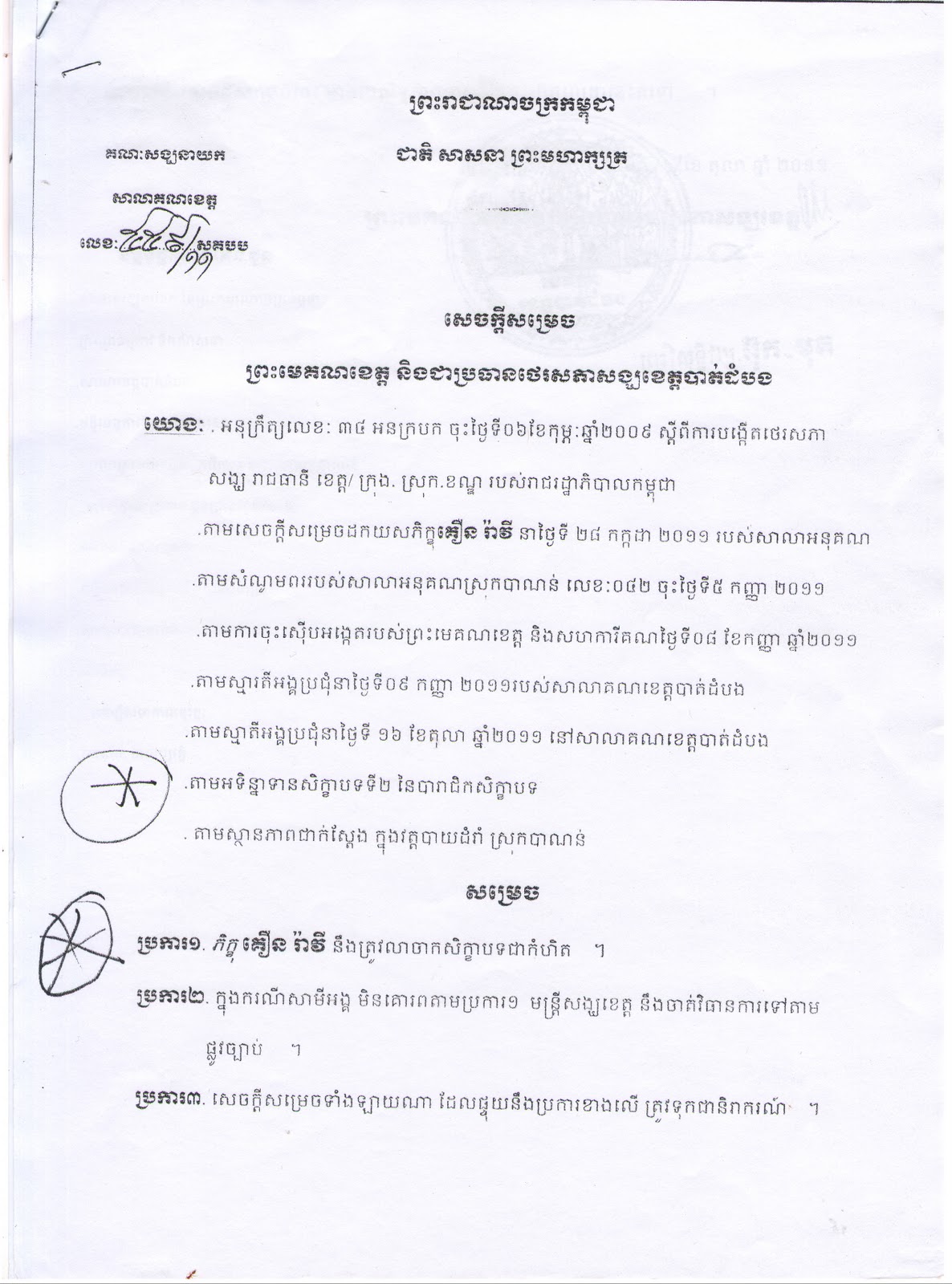
the problem happened with Venerable Koeun Ravy in Watt Soriyaaraam Bay-domram, Banan District, Battombong Province, South-West of Cambodia in the accusation of Vinaya offense on the code number 2 regarding "stealing".
According to the news, the scheme of stealing stemmed from few Achaa Watt or clergy leaders accused Ven. Keoun Ravy of stealing money in an amount of 200 dollars which it has been reserved for electricity bill. This accusation filed to the Kana Thera Saphea Khet or Provincial Buddhist Sangha Order (PBSO) by few clergy leaders in the temple in a support from one of the powerful local policemen. Referring this website, the PBSO didn't conduct investigation into the case but just follow the filing in the support of that powerful local policeman who is the member of the Cambodian People Party (CPP).
Seeing this, there are hundreds of laypeople including monks have paraded to support Ven. Keoun Ravy including opposition parties activists such as SRP and NRP in location. The people who came out to street to parade for the support of Ven. Keoun Ravy claimed that the Order by the PBSO is not just and it is politically motivated. Previously, Ven. Koeun Ravy has greeted the supports of opposition party members.
Ven. Keoun Ravy is 26 years old, he confirmed in the radio interview that "I accept to die in my saffron robe, I will not allow the authority to arrest and disrobed me as I have done nothing wrong in the Buddhist Vinaya. By this order, I cannot travel or escape to stay in any temple in the country, I must stay in this temple and accept to die in this place as a monkhood".
Note that, the order (directive) of the PBSO has limited time period 15 days in between October 16 to November 1, 2011 for Ven. Koeun Ravy to choose two options: to volunteer disrobe himself or be forced to disrobe.
Yesterday, Al Jazeera reporters spent full day with Venerable Preah Krou Luon Sovath for his socially engaged Buddhist activities with laypeople and the victims of forced eviction of Boeung Kok Lake residents.
The video shoot, comments and interviewing were extensively conducted.
Please, stay tune for his latest news on both domestic and international media as well as his visiting to the Boeung Kok Lake site for spiritual guidance, preaching them strength stemming from internal emancipation, non-violence and hope to those forced evicted residents. Note that many homes of urban poors in Beoung Kok Lake areas were devastated by bulldozers and arms authority in recent months. This human right violation has again shocked the world. The world can see that the government and authority are having no willingness to treat those urban poors fairly.
This is just a re-posting again from this link: http://luonsovath.blogspot.com/2011/10/latest-update-of-ven-preah-krou-luon.html#comments But we posted only the comments of Dhammaduta. I think Hanzze will not be minded.
Dear Hanzze;
Your words have become a conspiracy that after the authority marginalized him by threatening all students, friends and supporters to isolate him, now it comes to your term "financial isolation".
Your logic of not allowing monks to touch money is inapplicable in the present change. Buddha's Vinaya allow monks to carry or hold money in hand but not mentally attachable to it. Buddha allowed monks to use it wisely especially for the purpose of four necessary needs. More than this, Ven. Luon Sovath has his own Maggathayaka or follower who can take care all those money and monk's necessary belongings.
The works of defending human rights, animal rights and natural rights is the duty of Lord Buddha and all his followers including Bhikkhu monks and laypeople (Sangha). Your words are the same as Supreme Patriarch Tep Vong's who has considered the work of defending those rights belonging to laypeople only. Logically speaking, your words mean totally amputate the tasks of Lord Buddha and degrade the Buddha Dhamma.
Four Brahma Vihara encourages us to help others (human beings, animals and nature). It is the immeasurable quality of people mind ie:
1. Metta = Loving Kindness
2. Karuna = Compassion
3. Mudita = Sympathetic joy
4. Upekkha = Neutral mind or free of four biases:
1. The bias by love
2. The bias by hatred
3. The bias by delusion
4. The bias by scary
The journey of Venerable Preah Krou Luon Sovath for the defending of human rights in Cambodia has not been smooth and easy, but thing has kept his socially engaged Buddhist value moving and alive is from his internal strength and the supportive mindset of everyone. So please, continue to give him support as much as you can.
Venerable Preah Krou Luon Sovath has been in Cambodia after his long journey for the international campaign for the respect of human rights in Cambodia. Buddha and human rights is the same. Nonetheless, Buddha also valued and respected the rights of animal and nature as well.
However, his arriving in Cambodia saddened after he realized that his pet (dog) he has ever fed him food in the Watt Unaloum temple has been lost after he went to feed him food on the 21th of this October.
Pressure from the authority towards Venerable Preah Krou Luon Sovath has blatantly happened by threatening all his students, friends and supporters to isolate him; but now it has been happening with his dog pet who is considering his last friend living in Watt Unaloum.
Listen interviewing Preah Krou Luon Sovath by World Khmer Radio on October 12, 2011 broadcasted on October 16-17, 2011. Video clip re-posted from peakkdey's channel:
Summary of the Interview
Virak Oum: Firstly, I as well as other Cambodian people want to know your purposes of coming to Australia? Ven. Luon Sovath: My first intention in coming to Australia is by the kind invitation of Cambodian-Australians to attend Pchum Ben Festival here. As you know, I am marginalized by the Cambodian Buddhist leaders to banning me from staying in any temple there. With this banning, I cannot fully practice Buddhism and my opportunity in participating with Pchum Ben Festival doesn't have in Cambodia. Second intention is to seek for assistance from all Cambodians and main stream people to write letter, petition including other campaigns to request Cambodian supreme patriarch to drop those directives that have banned me from staying in the temple.
Virak Oum: Kona heard Preah Dejkun mentioned about the banning by the supreme patriarch by the directives accused Preah Dejkun on the incitement, let returning back to the background of this banning, why the supreme patriarch issued such directives? Ven. Luon Sovath: Po (yes), it is because of my social engagement in helping the people (farmers) who were facing with violence committed by the local authority in a land grabbing. But when I preached about non-violence and threatening or other unwholesome deeds, and as I am a monk, I have no material means to help them but to preach and to spiritually guide them. Hence, the authority was mad at me, later on there were directives from the supreme patriarch accused me of incitement and politic, and ordered all temples not to accept me to stay.
Virak Oum: According to the video clips broadcasted online by the International Human Rights Websites highlighted some violent acts of some monks towards Preah Dejkun, are those acts appropriate in Buddhism? Ven. Luon Sovath: Po (yes), actually in Buddhism if we look at scriptures especially Lord Buddha, He gave up secular power as the emperior to live a simple life and instructed people to love peace, practice Dhamma for enlightenment, and non-violence. I became a monk in accordance with this example and the Dhamma discourses in the scripture. I was ordained by the genuine preceptors and I have practiced the right Dhamma, not by other excuses. But look at those monks, they acted violent towards me and their acts were not independent. They worked in accordance with the signals of others. Those accusations occurred without durable to the Buddha Dhamma, the Vinaya and the state law. The acts as well as the directives were solely issued by the private individuals, not by the Bhikkhu monk assembly in accordance with the Buddha Vinaya. By those interferences of secular authority and the individual decision-making of the Bhikkhu monk, it led to violence over me and banning me from the temple which are not durable to the Buddha Dhamma and the national law.
Op-Ed: Can Cambodia
Lecture Series of CAN CAMBODIA
- Saturday, 15 October 2011 on "Engaged Buddhism: Challenges and Controversy" by Ven. Dr. Hok Savann, www.hoksavann.org
According to the lecture by Ven. Dr. Hok Savann, Cambodian Buddhism and Cambodian Society is inseparable. Thus, Buddhacakra (Buddhist dimension) and Anaacakra (secular dimension) must be lifted up equally. Buddhist laws and the universal human rights law is the same. Buddhist belief and Buddhist thought is considered a tort law or traditional law which is required the enforcement of secular law (national constitution and sub-decrees) to duly serve society.
Cambodian Buddhism is very substantial for legality, unity and social engagement. Without durable legality, unity, and social engagement, Cambodian society is hardly advancing. However, the respect of the rule of law must not happen only among lower citizens, the upper administrators must be duly obeying it as well. For instance, the lower thieves who stole chickens and ducks have immediately been punished but the thieves who are sitting on office chairs are immune of punishment.
Ven. Dr. Hok Savann doesn’t support the participation of Bhikkhu monks to vote or to choose secular leaders in each national election. Buddhist monks in Sri Lanka have become members of parliament but the image of Buddhist monks in the assembly are not appropriate at all among those lay law-makers and the practices of the assembly.
Regarding to Ven. Luon Sovath whose Buddhist top administrative banned from the temple is not due to the Viniya of Buddhist Sangha order. Ven. Luon Sovath’s activities and involvements with those victims of land grabs and forced evictions are not offending any chapter of the Viniya. It is just a social norm that Cambodia has never had monk like Ven. Luon Sovath. If the top administers of Buddhist Sangha accused Ven. Luon Sovath of violation of Viniya, they have to sit down and point out what parts of Viniya has he offended? Banning from the temple is an absolute order which Buddhist temples are owned by the laypeople; and it could not solve the problem. Otherwise, it is showing the not-independence of Buddhist Sangha administrative in Cambodia.
In conclusion, Cambodian Buddhist monks should not spend too much time in chanting mantra or building luxurious temples, they must pay attention to produce human resources and explain the laypeople on the daily basic needs to improve living standard; outreaching to the youth who are young seed of society.
Rules:
Skype is different from Paltalk because admin cannot control the coming voice, so participants must make sure that he/she is positioning in a quiet place. We are testing with skype in this time but if it is not working good, we will go to Paltalk which you can join our room at: CanCambodia in according to the schedule announced.
- No interrupting while lecture is on the process or others are speaking.
- Questions and discussions must be relevant to the topic.
- The whole session will be recorded for further research and public learning.
Plea:
We are working on a pilot project on Engaged Buddhism in Cambodia, so your contributions to access to any sources of papers, books and organizations on Engaged Buddhism in Cambodia are very welcome!
The next morning, Sovath woke at 4 a.m. He snuck quietly out of his pagoda, undetected by police, and slipped into the village. He went door-to-door, waking each family, until he had assembled a group of over 50 citizens - the elderly, the young, even pregnant women and children. They set out across the rice fields in the direction of the main road.
Sometimes the most effective defense of human rights begins with the simplest of questions.
Published on May 9, 2010
"Why can't I be here?"
"What law did I break?"
And sometimes, just: "Why?"
The latter was a question that the Venerable Luon Sovath began asking early in life. The 32-year-old grew up in Cambodia's Siem Reap province and came of age in the midst of Cambodia's vicious civil war. He witnessed horrific violence as the Khmer Rouge attempted to regain control of the country.
Growing up, there was rarely a clear answer to the question "why?" The violence was usually senseless; the injustice seemed systematic. Only two things were certain: First, the war was tearing his family apart; each of his 11 siblings had become entangled in the conflict. And second, he did not want to join them.
So at age 15, Sovath took a different path: He became a monk. His choice allowed him to escape harm during Cambodia's decades-long war, and instilled the virtues of karma, reflection, and justice.
Today, Cambodia's guns are mostly silent, but another battle rages: The fight over land rights. Since 2004, over 250,000 Cambodians have been victims of illegal government land seizures to make way for commercial development, plantations, dams, and mining concessions.
==>Listen the threatening voice of Supreme Patriarch Tep Vong towards Preah Krou Saccamuni Loun Sovath in part of the Voice of Democracy (VOD) broadcasted on May 5, 2011.
No. If you desire to behave like the ordinary people, behave like ordinary people, (so) it will not affect on the Viniya, the religion. If you (threat intoned) lead them to do so, disrobe first before you get involve with them, so it can be called you help them to seek justice. You (threat intoned) make religion damaged in among those people and you are called seeking justice?. The status of the monk are different from the status of the lay people. Go to live with those people, go (threat), no one prohibit that in accordance with the right of belief, but using the monk status is illegal, those supporters (threat intoned) are also illegal. (Unofficial translation by Pheak)
We are the devotees of Buddhism and students of Preah Krou Luon Sovath would like to appeal to all Dhamma friends and friends help support the Engaged Buddhism and humanitarian activity in Cambodia as following:
1.Write letter or send petition to Supreme Patriarch Tep Vong and Noun Ngeth to plea for the cancellation of orders to defrock, to silence freedom of speech of the monks, to accuse of incitement and to ban Buddhist temples in Phnom Penh and Siem Reap in allowing Preah Krou Luon Sovath to stay.
2.Help support the project of “Dhamma bag or Sanghaha Dhamma” in the amount of $5 each bag to offer to the victims of forced eviction and land grabbing.
3.Help support Preah Krou Luon Sovath directly for his social Engaged Buddhism.
If you have willingness to help support, please contact Preah Krou Luon Sovath directly at cell phone: (855)12-838-822, Skype: sovathloun, or Email: sovath_loun@yahoo.com
or through Paypal at https://www.paypal.com/cgi-bin/webscr?cmd=_s-xclick&hosted_button_id=T23G52CLA4XGN
A violent land dispute left four men in hospital and twelve in jail. Luon Sovath swapped his paintbrush for a camera after his family were shot. Video is a source of information, and information is a community's power. And become a human rights defender and video activist.
The problem of people and the path of Buddha are not different. Buddha's role was that of a man who saved people. So we need to follow the peaceful path of the Buddha. He has been threaten of defrocking, eviction and arrest.
Authority: this law prohibits you to participate in any activity that can destroy our religion. And religion belongs to the government. You can come to visit the villagers but you cannot lead them to protest.
I want to verify with the villagers. Everyone, did I gather and lead you to protest? No he does not. Did I lead you to protest? No, you don't. So you can see that I didn't lead them here to protest.
What is the problem brother? We are not going to stop until you meet with the head monk. I have to ask you to get out of the car to meet the head of the monks. Come on. What you are doing is wrong. We warned you but you do not listen to us. Get out. Drag him out.
They shot my relatives and they want to harm and to arrest the monk too. This is such an injustice. They arrested our villagers and now they want to arrest our monk too. This is unfair.
Please you cannot arrest the monk. They said they are not going to arrest him.
They have not been able to successfully defrock me. So they are finding other methods, like forced eviction. My room which I have lived in for 20 years as a monk has been taken. But I will struggle to get justice for people, for society and for myself.
A Cambodian monk, who has been targeted by the government for his social activism, says the country's top leaders are responsible for the poverty and suffering of some of its citizens.
Venerable Luon Sovath came to prominence after a forced eviction from his village in 2009 turned violent, and police opened fire on land protesters, injuring four people.
The villagers called the monk in to help document the incident and advocate on their behalf.
This began his work travelling the country, helping to inform people of their rights and to protest against land grabs.
He says this practice of what he calls "engaged Buddhism" has resulted in him being arrested and being threatened with beatings, death, and defrocking as a monk.
In April this year, the ruling body for Buddhist monks in Cambodia banned Venerable Luon Sovath from going to temples in Phnom Penh or Siem Reap.
Presenter: Liam Cochrane
Speaker: Venerable Luon Sovath, a Cambodian monk and social activist
Hence, Venerable Preah Krou Luon Sovath has witnessed with land grab and intimidating from the rich and authority since 2005 in his birth place. He has risen up to involve with the suffered people in the expect to lead a better change for them. As a monk, his weapon is the compassionate devotion and the use of non-violence mean for the sake of human beings.
Words of Lord Buddha have encouraged Buddhist monks to wander near and far to preach the Dhamma beautiful on both the beginning and the ending in the purpose of bringing most benefits to the unfortunates, the poor, the weak and the human kind. World's religions have shared similar characteristic as those religious men are responsible for correct understanding of the teaching, implement the teaching accordingly, and outreach their compassion to all directions of the world. Buddhist engaged monks have carried out this mission worldwide since the Buddha was alive and the tasks have been continuing nowadays.
In case of Cambodia, the ravaged war has not discouraged Cambodian Buddhist monks from engaging with the communities and society. Many Buddhist-based organizations are stationing importantly on improving livelihood of the destitute people. Hence, Venerable Preah Krou Luon Sovath has witnessed with land grab and intimidating from the rich and authority since 2005 in his birth place. He has risen up to involve with the suffered people in the expect to lead a better change for them. As a monk, his weapon is the compassionate devotion and the use of non-violence mean for the sake of human beings.
Currently, at the notorious land grab and forced eviction of Beoung Kok Lake in the heart of Phnom Penh city, Ven. Sing Tonly has firmly stood in front of the gun men of servants of the rich and the powerful. His surveillance stemmed from the injustice in society and the land concession lasting 99 years in the scrupulous contract between the government and the tycoons as well as the foreign business owners. According to his word, the concession period of 99 years is to murder the Cambodian nation.
Ven. Sing Tonly has emerged as another Buddhist monk who has seen the land concession is not justifiable for the development. The forced eviction happened by those land concessions are not a rational for development in Cambodia, but he has seen it as the excuse to plunder this nation and it can lead to the extinction of this nation in the future.
For more information, please listen to his interviewing with the Khmer Post below:
By Pen Bonna Radio France Internationale Translated from Khmer by Soy
Buddhism teaches that we all come to this world naked, when we die, we will not take anything with us with the exception of the sins and good deeds that we perform. Therefore, true Buddhist believers should not fight each others to fulfill our greed.
Buddhism is the state religion and it is worshiped by Buddhist Khmer families in general. For example, during each year’s Pchum Ben celebration, no Cambodian families would miss visiting a pagoda, whether they are rich or poor. However, when you compare the current social problems in Cambodia and the [intrinsic] value of Buddhism, one can see that the majority of Cambodians only worship Buddhism superficially only, they do not worship Buddhism out of their heart or out of their true belief at all. Why is that so?
The 15 days of the Kan Ben and Pchum Ben celebrations ended on Tuesday. Each pagoda in the kingdom was busy receiving Buddhist devotees. People from all creeds tried to visit a pagoda to celebrate Pchum Ben. This action seems to show that Cambodians are true believers of Buddhism, of sins, of “retributions” which are part of the Buddhist core.
Based on the busy traffic in pagodas during the Pchum Ben season, it is hard to believe that the Cambodian society is riddled with so many social problems because Buddhism provides a just philosophy that everybody can believe and worship. The foremost philosophy that Buddhism teaches to people is: “Do the right deeds and you will reap good deeds, do the wrong deeds and you will reap bad deeds” during this lifetime or during the next lifetime. However, Cambodia had continuously met with unending war and genocide, as well as major and minor problems.
Analysts who follow the situation of the Cambodian society have pointed out 2 major issued that we should reflect on. The first issue is the fact that a number of Buddhist followers worship the religion without clearly understanding the teachings of Buddha. Any religion aims to direct people to perform good deeds, but the problem stems from the fact that the worshipers do not practice their belief properly because they do not understand and they twist religion for other purposes. The second issue stems from the fact that people are using religion only as a shield, but they do not truly believe it in their heart and they do not practice it according to Buddhist meaning at all.